Chinese Numbers Song Lesson Plan: Teach 1-10 in Mandarin With a Song and One-Hand Signs
8 min read by Tim
Numbers look like the easy unit. Ten words, no grammar, done by Friday. Then you ask 你几岁? and get a blank look, or a student counts 一 二 三 四 五 perfectly in a row but can't tell you what 七 is on its own.
Counting in a row is a song. Knowing a number is a skill. This free 40-minute lesson plan uses both: the Chinese Buddy song Numbers 1-10 to get the sounds in, one-hand number signs so every student answers at once, and two games that make them use numbers out of order.
What do you need for this Chinese numbers song lesson?
- The song Numbers 1-10 from the Song Finder (Numbers, age, money & time). It counts from 一 to 十.
- Optional extension: How Old Are You? from the same topic (你几岁?我……岁).
- A whiteboard, ten sticky notes with 一 to 十 on them, and space for students to walk around.
Works for kindergarten through middle school. Adaptations for each level are at the end.
Which words do students learn?
- 一 yī, 二 èr, 三 sān, 四 sì, 五 wǔ
- 六 liù, 七 qī, 八 bā, 九 jiǔ, 十 shí
Two things worth saying out loud. First, 四 sì and 十 shí sound alike to English ears; the tones are the difference (falling vs rising), so give them a hand gesture each. If your class doesn't have tone gestures yet, week 1 of How to Teach Mandarin Tones: A 4-Week Plan sets them up. Second, 一 changes tone inside words later on. For counting, it's just yī. Save the rule for another day.
What are the Chinese number hand signs for 1-10?
Chinese speakers can show every number from one to ten on one hand. Kids love it, and it gives you a silent answer from the whole room.
- 一 to 五: close to what students already do. One finger, two (index and middle), three, four with the thumb tucked in, then an open hand. Three varies: some people use the last three fingers, some the first three.
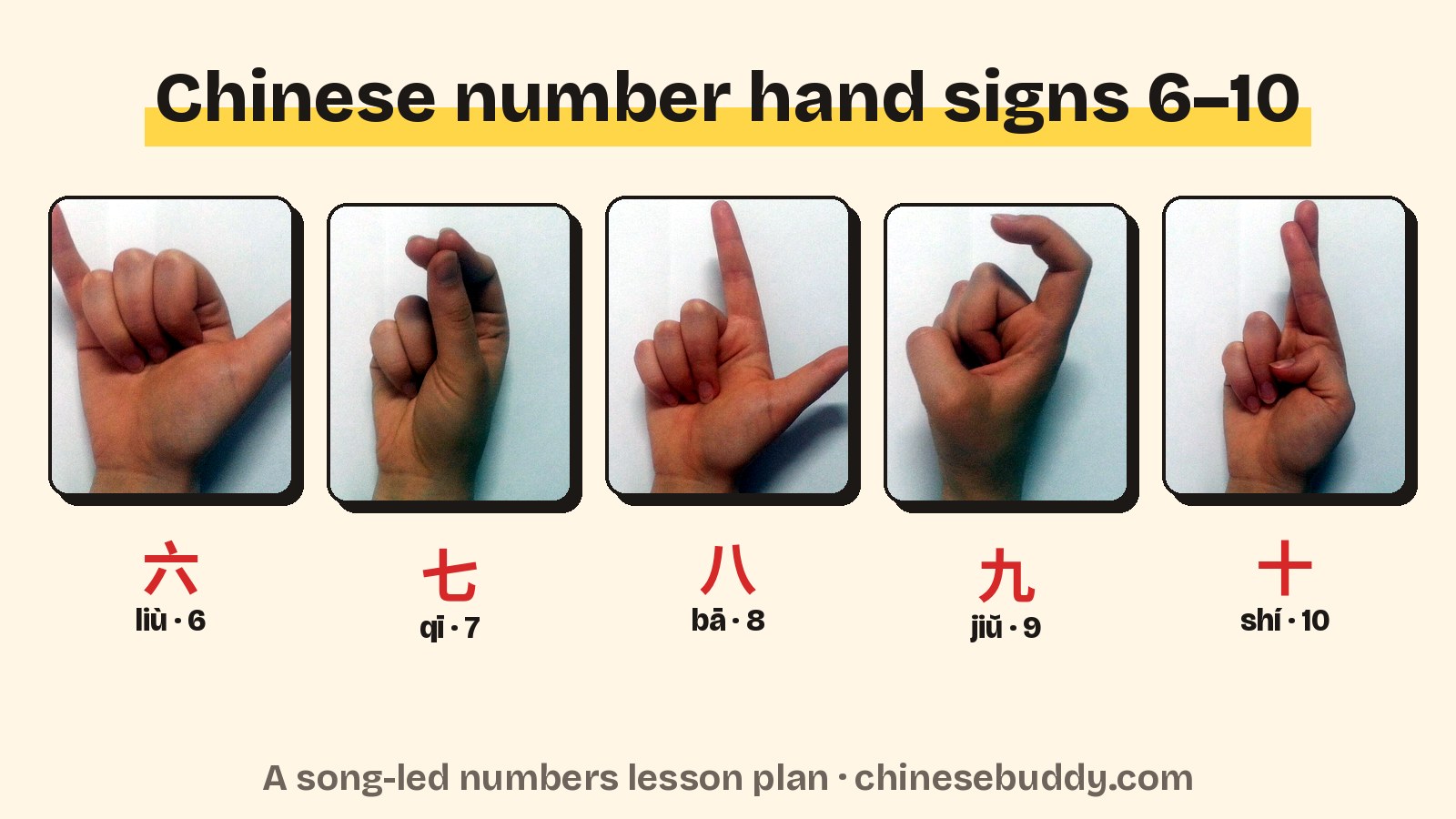
- 六: thumb and little finger out, like a phone.
- 七: fingertips of the thumb, index and middle finger pinched together.
- 八: thumb and index finger out, like an L.
- 九: index finger bent into a hook.
- 十: index and middle finger crossed, or a closed fist, or two index fingers crossed to make 十.
A regional caveat: the signs for 6 to 10 aren't universal. They differ between regions and families, and Taiwan, Hong Kong and parts of mainland China don't all agree, especially on 七, 八 and 十. The cover photo shows one common set. Pick one set, tell the class it's one way, not the only way, and invite heritage students to show how their family does it. That conversation is a bonus culture lesson.
A 40-minute lesson plan for Chinese numbers 1-10
1. Silent count-in (3 minutes)
Don't speak. Hold up one finger, then two, then three, and wait. Someone will say a number in English. Shake your head, smile, and say 一. By 三 most of the room is saying it with you. Go to 五 and stop.
2. 一 to 五 with signs (5 minutes)
Say each number twice while showing the sign. Then mix them up: you sign, they say. Then flip it: you say, they sign. Watch hands, not mouths. Anyone holding up the wrong number gets a second look from you, not a correction in front of everyone.
3. Teach the song Numbers 1-10 (8 minutes)
Play it once while students only listen and show the number signs they know. Play it again and have them sing just the numbers. The third time, stop the song at random and freeze: whatever number you stopped on, everyone holds up the sign. That freeze is the moment you find out who's singing along and who actually knows the numbers.
4. 六 to 十 one-hand signs (7 minutes)
Teach the new signs one at a time, with the caveat above. Students make up a reason for each one (六 is a phone, 十 is a cross). Their reasons stick better than yours. Then play "sign it, don't say it": you say a number, they show it. Speed up until somebody laughs.
5. 抱团 Number Huddle (7 minutes)
Students walk around the room. You call a number, 三! and they form groups of exactly three. Anyone left over does a quick task: count from 一 to 十, show you the sign for 七, or sing a line of the song. Full rules and a maths twist (call 二加二 instead of 四) are in 12 No-Prep Mandarin Classroom Games.
6. Countdown 十 to 一 and exit (5 minutes)
Everyone crouches. Count down together from 十 to 一, showing each sign, rising a little on each number, and jump on 一. Counting backwards breaks the song order, which is the point. Then the exit: stand at the door, show a sign, and each student says the number before leaving. Use the same countdown all term to line up or tidy up; more routines like it are in Stay in Mandarin: 7 Classroom Routines.
Extension: How Old Are You? (5 extra minutes)
If the room is ready, add the Song Finder song How Old Are You? and one question: 你几岁? (nǐ jǐ suì, how old are you?). Students answer 我……岁 and hold up their age in one-hand signs. Ages over ten need two hands or a quick 十 plus a number, which sets up 十一 to 十九 for next lesson. With teenagers, keep it playful: they can answer for a pet or a cartoon character.
How do you adapt the numbers lesson for different levels?
- Kindergarten: 一 to 五 and the song only. Signs, Number Huddle with small numbers, countdown from 五. No writing.
- Lower primary: the full plan. Add writing 一 二 三 on the whiteboard; kids love that the first three are just lines.
- Upper primary: add 十一 to 九十九 (十一 is 十 and 一; 二十 is two 十s), then phone numbers and the How Old Are You? extension.
- Middle school: maths Huddle (十减六), 两 vs 二 (两个, but 二 when counting), and a quick 你几岁 survey.
- Homeschool: count stairs, Lego bricks or grapes, and sign the number before you eat one.
What about a numbers worksheet?
There's no downloadable numbers sheet for this lesson, so here's a one-page layout you can make in five minutes or draw on the board:
- Match: 一 to 十 down one side, dot groups down the other.
- Hand signs: five drawn hands (six to ten); students write the number under each.
- Me in numbers: 我____岁。我有____个朋友。
More song-based formats that plug straight in are in Printable Mandarin Worksheets That Actually Get Used. The same song, game and worksheet rhythm works for colors too: see the 45-minute colors song lesson plan. For songs on other beginner topics, try Chinese songs for kids by topic.
Where can you find the song videos and more printables?
If you'd rather not build materials yourself, Club Lǎoshī is the Chinese Buddy membership for teachers, with song videos and classroom printables. Want to see what song-matched printables look like first? The free Basic Greetings Classroom Pack has five PDFs for the song 我叫Tim. It's a greetings pack, not a numbers pack.
Ten numbers, one song, one hand. Then make them count backwards.
More classroom song videos and printables live at chinesebuddy.com.
Tim is the original founder, creator and dreamer of all things on Chinese Buddy. He can be contacted here.
Cover photos: Mariusz Swornóg, Counting b6–b10, CC BY-SA 4.0, via Wikimedia Commons (cropped and arranged with labels; the cover is shared under the same license).
中文数字歌教案:用一首歌和单手手势教1到10
数字看起来是最简单的单元。十个词,没有语法,周五前就教完。可是你一问"你几岁?",学生一脸茫然;或者一口气能把"一二三四五"数得很顺,单独问"七"是多少却答不上来。
按顺序数是一首歌,认得每个数字才是本事。这份免费的40分钟教案两样都用上:用 Chinese Buddy 的歌曲 Numbers 1-10 把发音先唱进去,用单手数字手势让全班同时作答,再用两个游戏让学生打乱顺序使用数字。
这节数字歌课需要准备什么?
- Song Finder(Numbers, age, money & time)里的歌曲 Numbers 1-10,从一数到十。
- 可选延伸:同一主题里的 How Old Are You?(你几岁?我……岁)。
- 一块白板,十张写着一到十的便利贴,还有能让学生走动的空间。
适合幼儿园到初中。各年龄段的调整方法放在最后。
学生要学哪些词?
- 一 yī、二 èr、三 sān、四 sì、五 wǔ
- 六 liù、七 qī、八 bā、九 jiǔ、十 shí
有两点值得说出来。第一,对说英语的学生来说,"四"和"十"听起来很像,区别在声调(第四声和第二声),所以给它们各配一个手势。如果学生还没学过声调手势,《怎样教普通话声调:四周计划》的第一周会教你怎么开始。第二,"一"以后在词语里会变调,数数时就念 yī,变调规则留到以后再讲。
1到10的中文数字手势怎么比?
说中文的人用一只手就能比出一到十。孩子们很喜欢,你也能一下子看到全班的答案,而且不用出声。
- 一到五:和学生平常的比法差不多。一根手指,两根(食指和中指),三根,四根(大拇指收起来),然后张开整只手。"三"有不同比法:有人用后三根手指,有人用前三根。
- 六:伸出大拇指和小指,像打电话。
- 七:大拇指、食指和中指的指尖捏在一起。
- 八:伸出大拇指和食指,像字母 L。
- 九:食指弯成钩子。
- 十:食指和中指交叉,或者握拳,或者两只手的食指交叉成"十"字。
注意地区差异:六到十的手势并不统一。不同地区、不同家庭的比法不一样,台湾、香港和中国大陆各地也不完全相同,尤其是七、八和十。封面图片只是其中一种常见比法。选定一套,告诉学生这是一种比法,不是唯一的比法,再请华裔学生示范自己家里怎么比。这段对话本身就是一堂文化课。
中文数字1到10的40分钟教案
1. 无声数数导入(3分钟)
先不说话。举起一根手指,再两根,再三根,然后等着。总会有人用英语说出数字。你摇摇头,笑一笑,说"一"。到"三"的时候,大部分学生已经跟着你说了。数到"五"就停。
2. 用手势学一到五(5分钟)
每个数字说两遍,同时比手势。然后打乱顺序:你比,他们说。再反过来:你说,他们比。看手,不看嘴。谁比错了,你多看他一眼就好,不用当着全班纠正。
3. 教歌曲 Numbers 1-10(8分钟)
第一遍只听,学生比出已经会的数字手势。第二遍让他们只唱数字。第三遍随机暂停,全班定格:停在哪个数字,大家就比出那个手势。这一停,你就知道谁只是跟着唱,谁是真的认得数字。
4. 单手手势六到十(7分钟)
一次教一个新手势,并讲清上面的地区差异。让学生自己给每个手势编个理由("六"像电话,"十"是个十字)。他们自己编的理由比你讲的记得牢。然后玩"只比不说":你说一个数字,他们比出来。越来越快,直到有人笑出来。
5. 抱团(7分钟)
学生在教室里走动。你喊一个数字:"三!"他们就要组成正好三个人的小组。落单的学生做一个小任务:从一数到十、比出"七"的手势,或者唱一句歌。完整规则和数学变化(喊"二加二"而不是"四")都在《12个零准备中文课堂游戏》里。
6. 从十倒数到一,然后离场(5分钟)
大家蹲下。一起从十倒数到一,每个数字都比手势,每数一个就站高一点,数到"一"一起跳起来。倒着数会打破歌里的顺序,这正是目的。然后离场:站在门口比一个手势,每个学生说出那个数字才能离开。整个学期都可以用同样的倒数来排队或收拾东西;更多类似的常规见《坚持说中文:7个课堂常规》。
延伸:How Old Are You?(多5分钟)
如果学生准备好了,加上 Song Finder 里的歌曲 How Old Are You? 和一个问题:"你几岁?"学生回答"我……岁",同时用单手手势比出年龄。十岁以上要用两只手,或者先比"十"再比一个数,正好为下节课的十一到十九做铺垫。对青少年可以玩得轻松一点:替自己的宠物或卡通人物回答。
怎样根据不同程度调整数字课?
- 幼儿园:只学一到五和歌曲。比手势,用小数字玩抱团,从五开始倒数。不写字。
- 小学低年级:完整教案。在白板上写一、二、三,孩子们很喜欢前三个字就是几条横线。
- 小学高年级:加上十一到九十九(十一就是十和一,二十就是两个十),然后是电话号码和 How Old Are You? 延伸。
- 初中:数学版抱团(十减六),"两"和"二"的区别(两个,但数数时说二),再做一个简单的"你几岁"调查。
- 在家学习:数楼梯、乐高积木或葡萄,吃一颗之前先比出数字。
数字练习纸怎么办?
这节课没有可下载的数字练习纸,下面是一个一页的版式,五分钟就能做好,也可以画在白板上:
- 连线:一边写一到十,另一边画点数。
- 手势:画五只手(六到十),学生在每只手下面写数字。
- 用数字介绍我:我____岁。我有____个朋友。
《真正用得上的中文打印练习纸》里有更多可以直接套用的歌曲练习形式。同样的"歌曲、游戏、练习纸"节奏也适用于颜色,见《用一首歌教中文颜色:45分钟教案》。其他初级主题的歌,可以看按主题分类的中文儿歌。
哪里可以找到歌曲视频和更多打印资料?
如果不想自己做材料,Club Lǎoshī 是 Chinese Buddy 给老师的会员计划,有歌曲视频和课堂打印资料。想先看看配合歌曲的打印资料是什么样子?免费 Basic Greetings 课堂资料包里有五份配合《我叫Tim》的PDF。注意:它是问候语资料包,不是数字资料包。
十个数字,一首歌,一只手。然后让学生倒着数。
更多课堂歌曲视频和打印练习,见 chinesebuddy.com。
Tim 是 Chinese Buddy 的原创创始人、内容创作者和梦想实践者。如需联系,可在此留言。