Radical Racers 部首赛车: A Free Chinese Radicals Game for the Classroom
7 min read by Tim
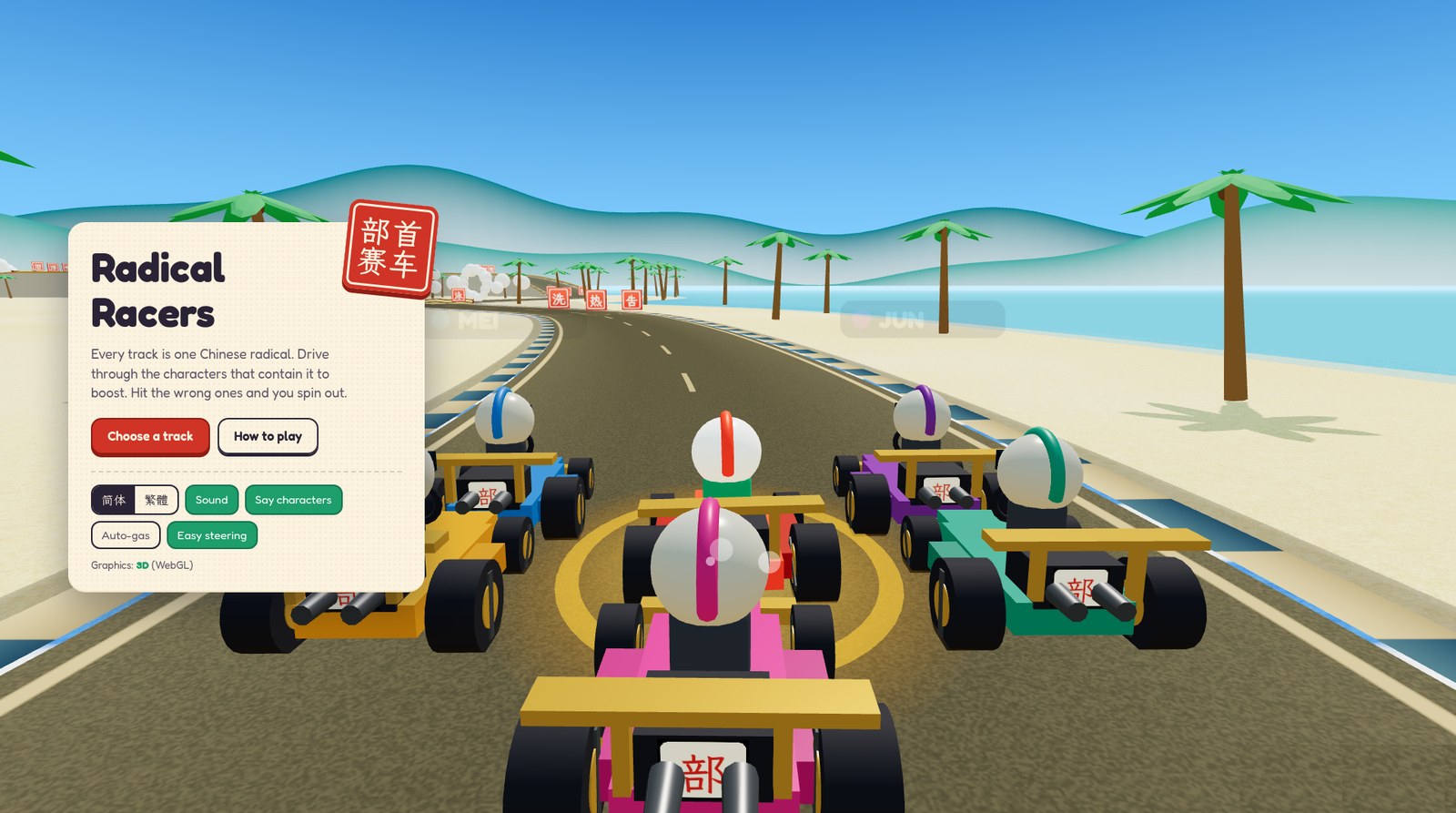
A student spots 氵 in 河, steers into it and gets a speed boost. A moment later, another character is coming down the road. Same radical. New decision. That's Radical Racers 部首赛车, a free Chinese radicals game I've made for the browser. It's a kart race where noticing the parts inside Chinese characters helps you go faster. No sign-up, no download, and no worksheet to prepare. Open Radical Racers and you're ready.
What is Radical Racers, and how do you play?
Every track focuses on one radical. Before the race, a short introduction shows the radical and example characters. On the water track, for instance, the thing to look for is 氵, 三点水 (sān diǎn shuǐ).
Then it's three laps against five rival karts. Your kart moves automatically from GO: there are no accelerate or brake buttons. Steer through a character containing the target radical for a speed boost. Hit a wrong one and you spin out.
Most character gates leave an open lane, so a beginner who isn't sure can dodge the choice and keep driving. Some fill all three lanes. That gives students room to find their feet without making character knowledge optional.
Finish first to unlock the next track. There are twelve radical tracks, including water 氵, fire 火/灬, mouth 口, tree 木, person 亻, hand 扌 and speech 讠/言. Each new track gives students a different part to hunt for.
Why is a Chinese radicals game fun?
The reward comes straight away. Spot the right part, drive through it, feel the boost. Miss it, spin out, try again. There's a race to finish, rivals to catch and another track to unlock.
Chinese Buddy songs play in the background while you race. At the finish there's an award ceremony and a celebration. The top-10 leaderboard gives students another reason to return, though beating yesterday's time is a perfectly good classroom goal too. You don't need to make every activity a competition between classmates.
For a teacher, the useful bit is what sits inside all that movement: students keep looking closely at characters. The practice is part of the race, not a question screen interrupting it.
Why is it useful for teaching Chinese radicals?
Beginners often see a new character as one complicated picture. Teaching Chinese radicals gives them a smaller thing to recognise: “I know that part.” On a water track, they see that part again and again inside different characters.
That is the point of radical-first recognition. Our six radical-first classroom activities discuss Xu, Chang and Perfetti's 2014 study: grouping characters by shared radicals helped learners on immediate tests, but the advantage did not last at the two-week follow-up. It's a reason to teach families and bring them back, not evidence that this game has been tested or will guarantee retention.
Radical Racers supplies quick, repeated exposure to those families. It doesn't replace explaining a character's meaning, reading it in a sentence or learning to write it. A radical can be a useful meaning clue, not a complete definition. Use the race for noticing; use the lesson around it for understanding.
If you want a separate focus on writing, the Character Coach post explains that side of the Chinese Buddy story. Different tools, different jobs.
A ten-minute radical lesson you can try today
- Teach one family (about 2 minutes). Write 氵, 河, 海 and 洗 on the board. Give their meanings and readings, and have students point to the shared part. The radical-first activities have more ways to introduce it.
- Race one track (about 5 minutes). Model steering, then let students try the water track. In pairs, one drives while the other watches for the radical; swap drivers for the next attempt. Five minutes is your practice window, not a promised race length.
- Remember three characters (about 3 minutes). Close the game. Students write three characters they drove through and circle the radical. Let beginners check the pre-race examples if they need help. Ask for the meaning or reading of one character you've already taught.
That last step matters. “I won” tells you about the race. Three characters on paper tell you what the student noticed. Bring the same family back for a short check another day.
Will it work on classroom computers and iPads?
- Desktop: use the left and right arrow keys to steer.
- Phone or iPad: tilt the device left and right. On iOS, allow motion access when starting a race. Check that permission on a school-managed device before handing it to a student.
- Easy steering: leave it on while students learn the controls; it follows the road's curves for them.
- Simplified or traditional: use the 简体/繁體 toggle to match your class.
- Character audio: the “Say characters” toggle lets you turn spoken characters on or off.
Try it on the devices and school network you'll actually use. A quick teacher test is worth more than discovering a blocked page halfway through a station rotation.
Where does it fit in a Mandarin lesson?
Use one familiar track as a warm-up, a computer station, an early-finisher task or an end-of-unit review. It can be a short brain break with a character focus, or a homework link with the same three-character follow-up. The shared URL keeps setup simple.
If you want to start with sound before shape, find the Mouth Radical Song in the Song Finder, then look for 口 in familiar characters. For screen-free alternatives, keep 12 No-Prep Mandarin Classroom Games handy.
And if songs are already part of your routine, Club Lǎoshī has song-matched printables for the work around the game. Radical Racers itself is free; you don't need a membership to play.
One radical, a few familiar characters, three laps. Try Radical Racers 部首赛车 and see which character family your class can spot.
More classroom song videos and printables live at chinesebuddy.com.
Tim is the original founder, creator and dreamer of all things on Chinese Buddy. He can be contacted here.
Radical Racers 部首赛车:免费的中文部首课堂游戏
学生在“河”里发现“氵”,把车开过去,马上加速。紧接着,又一个汉字出现在前方。同一个部首,新的选择。
这就是我做的免费网页中文部首游戏 Radical Racers 部首赛车。这场卡丁车比赛里,认出汉字中的部件就能帮你跑得更快。不用注册,不用下载,也不用准备练习纸。打开部首赛车就能开始。
部首赛车是什么?怎么玩?
每条赛道只练一个部首。比赛前,简短介绍会展示这个部首和例字。比如三点水赛道,要找的就是“氵”(三点水)。
接下来,与五辆对手的车跑完三圈。发车后,你的车会自动前进,没有油门或刹车按钮。开车穿过含有目标部首的汉字就会加速;撞上错误的字,车就会打转。
大多数汉字关卡留有一条空车道,不确定答案的初学者可以绕过去,继续比赛。有些关卡会占满三条车道。这样既给学生适应的空间,也让认字能力真正派上用场。
拿到第一名,就能解锁下一条赛道。游戏有十二条部首赛道,包括三点水氵、火/灬、口、木、单人旁亻、提手旁扌和言字旁讠/言。每换一条赛道,学生就要寻找不同的部件。
中文部首游戏为什么好玩?
反馈来得很快。认出正确的部件,开过去,马上感到加速。看错了,打转,再试一次。有比赛要完成,有对手要追,还有下一条赛道等着解锁。
比赛时,背景播放的是 Chinese Buddy 歌曲。冲线后还有颁奖和庆祝。前十名排行榜给学生一个再玩的理由,不过,超过自己昨天的成绩,也是很好的课堂目标。不是每个活动都需要同学之间比输赢。
对老师来说,真正有用的是这些动作里藏着的事:学生一直在仔细看汉字。练习就是比赛的一部分,不是突然跳出来打断游戏的题目。
它为什么有助于教中文部首?
初学者常常把新汉字看成一整幅复杂的图。教部首,就给了他们一个更小、更容易认出的部分:“这一块我认识。”在三点水赛道上,他们会在不同的字里反复看到这一块。
这就是先认部首的意义。我们的六个部首优先课堂活动谈到 Xu、Chang 和 Perfetti 2014 年的研究:按共同部首分组学字,有助于课后立即进行的测试,但两周后的追踪测试中,优势没有保持下来。这支持的是按部首家族教学,并且回来复习,并不代表这款游戏经过了实验验证,也不保证长期记忆效果。
部首赛车提供快速、反复接触这些汉字家族的机会。它不能代替讲字义、在句子里读字或学习书写。部首可以提供字义线索,却不是完整的定义。用比赛练观察,用比赛前后的课帮助理解。
如果你想另外练习书写,Character Coach 那篇文章介绍了 Chinese Buddy 在这方面的尝试。不同工具,各有用处。
今天就能试的十分钟部首课
- 教一个家族(约2分钟)。在白板上写氵、河、海、洗,讲读音和意思,让学生指出共同部件。部首优先活动里还有更多导入方法。
- 玩一条赛道(约5分钟)。先示范转向,再让学生试三点水赛道。两人一组时,一个开车,一个观察部首;下一次交换。五分钟是练习时段,不是保证一场比赛需要的时间。
- 记住三个字(约3分钟)。关掉游戏,让学生写出开车经过的三个汉字,圈出部首。初学者需要帮助时,可以再看赛前例字。然后请他们说出一个已经教过的字的意思或读音。
最后这一步很重要。“我赢了”告诉你比赛结果;纸上的三个字告诉你学生注意到了什么。过几天,再用一个简短活动复习同一组字。
教室电脑和 iPad 能玩吗?
- 电脑:用左右方向键转向。
- 手机或 iPad:左右倾斜设备转向。iOS 开始比赛时需要允许动作访问。学校管理的设备,最好先检查权限再交给学生。
- 简单转向:学生熟悉操作时可以保持开启,游戏会帮他们跟随道路弯曲。
- 简体或繁体:用游戏中的简繁切换按钮,配合你的课堂。
- 汉字语音:用“Say characters”按钮开启或关闭汉字朗读。
先用课堂上真正要用的设备和学校网络试一次。老师花一点时间测试,总比轮到电脑学习站时才发现网页被拦住好。
它适合放在中文课的哪个环节?
熟悉的赛道可以当课前热身、电脑学习站、提前完成任务后的活动,或单元结束复习。也可以当一个带认字目标的短暂课间放松活动,或者把链接当作业,配上同样的“三个字”任务。共用一个网址,准备很简单。
想先听声音、再看字形,可以在Song Finder 找到 Mouth Radical Song(口部首歌),再从熟悉的字里找“口”。需要不用屏幕的替代活动,可以看《12个零准备中文课堂游戏》。
如果你的课堂本来就在用歌曲,Club Lǎoshī 有配合歌曲的打印资料,可以用在游戏前后的教学里。部首赛车本身免费,不需要会员就能玩。
一个部首,几个熟悉的字,三圈比赛。试试 Radical Racers 部首赛车,看看你的学生能认出哪个汉字家族。
更多课堂歌曲视频和打印练习,见 chinesebuddy.com。
Tim 是 Chinese Buddy 的原创创始人、内容创作者和梦想实践者。如需联系,可在此留言。